KeyQuest
A Pokemon-inspired RPG where you catch songs by playing them on a real piano. Practice comes first, the adventure comes second, and a grown-up holds the key.
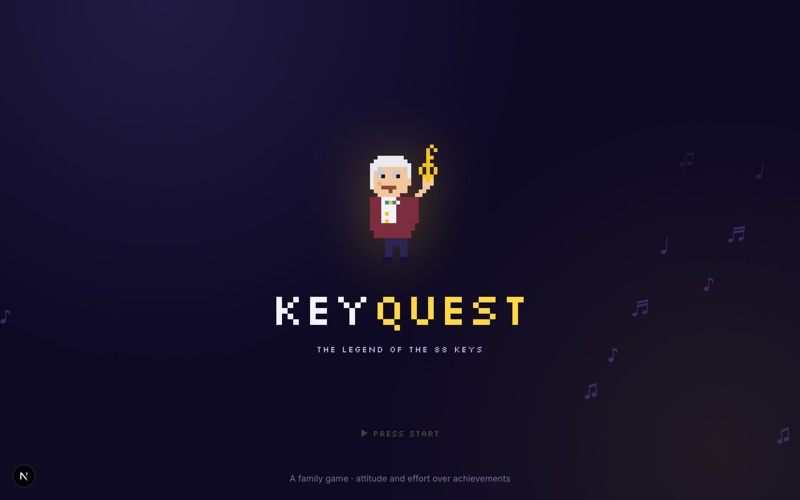
KeyQuest started as a question a lot of parents ask: how do you get a child to want to practice? The answer here is not a chore chart. It is a Pokemon-inspired world - the Land of the 88 Keys - where Professor Octave sends you on quests and you catch songs by actually playing them on the piano. The instrument is the controller.
The whole score is generated. Rather than licensing loops or hand-sequencing every track, the game carries a custom song generator built on music theory - scales, modes, chord function, voice leading, and section forms - so a piece is composed from rules rather than assembled from samples. Every track in the game, including the one below, came out of it.
The design constraint is the interesting part. Before the world opens each day, the game puts up a practice gate: a timer, the actual assigned pieces, and a line that says there is nothing to win here, just the playing. The map only unlocks when a grown-up confirms the practice happened. The game cannot be farmed for progress without the instrument.
The opening theme, C major at 104 bpm. Generated by the game's own song engine, captured straight out of the running game - it plays once per save file, which makes it the least-heard piece in KeyQuest.
Want something like this for your business? Get a free quote from a Chico web designer.